By Subcomandante Marcos. Translated from Spanish into English for Axis of Logic by Manuel Talens and revised by Mary Rizzo (Tlaxcala*)
Reader Beware: If you have heard of the Zapatista National Liberation Army in the mountains of Southeast Mexico, you are numbered among the relatively few. If you have come to understand anything about the foundations of their power, you are among the fewer still. If you have heard and understood, you then know they are a force with which to be reckoned in the war against the Global Corporate Empire. When you read Sub-comandante Marcos' address to the Meeting of Intellectuals in Guadalajara, Jalisco (Mexico), on March 21, 2006 (below), you will further understand why the enemy fears them.
Marcos' message rings with the clarity of a mountain spring and his delivery with the force of the avant-garde. But it is not the jaded "avant-garde" of anemic personalities like Andy Warhol and his NYC groupie. Sub-comandante Marcos invents language that penetrates and challenges the inchoate assumptions and post-modern weltanschuaang that has gained transient power for which its sponsors are utterly unworthy. Here, Marcos amplifies Elías Contreras' gift to humanity with a poetry that drives the Contreras' spike home into the heart of the villain and at the same time, recruits and marshals the leaders of the world revolution. - Les Blough, Editor
Original in Spanish at Rebelión
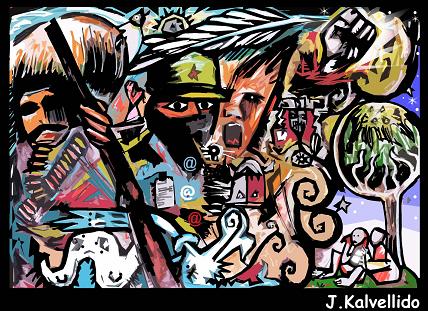
Original Graphic for Axis of Logic by JUAN KALVELLIDO
Another Theory?
Several years ago, the Tapatía dawn surprised Elías Contreras, an EZLN investigation commissioner, while sitting on a bench of the park, which is opposite the cathedral that imposes its double power - both symbolic and real - upon the city of Guadalajara1. Elías Contreras had come to this city to first meet the Russian at his stand of bran cakes and later on the Chinese man Feng Chu in the Mutualista public baths. This happened at the time he was trying to solve the unknown case of Evil and the Villain. To whoever doesn’t know it, Elías Contreras was an EZLN base support comrade, a veteran of war who helped the EZLN General Command on what you call “detective” labors but we rather call “investigation commission” labors.
But, before meeting the Russian’s disconcerting cakes and the Chinaman’s parsimony, Elías Contreras had spent time sitting in one of the downtown parks of this city of Guadalajara, scribbling drawings, single phrases, complete paragraphs and vague lines in his notebook while he waited for the sun to stain the eastern wall of the cathedral.
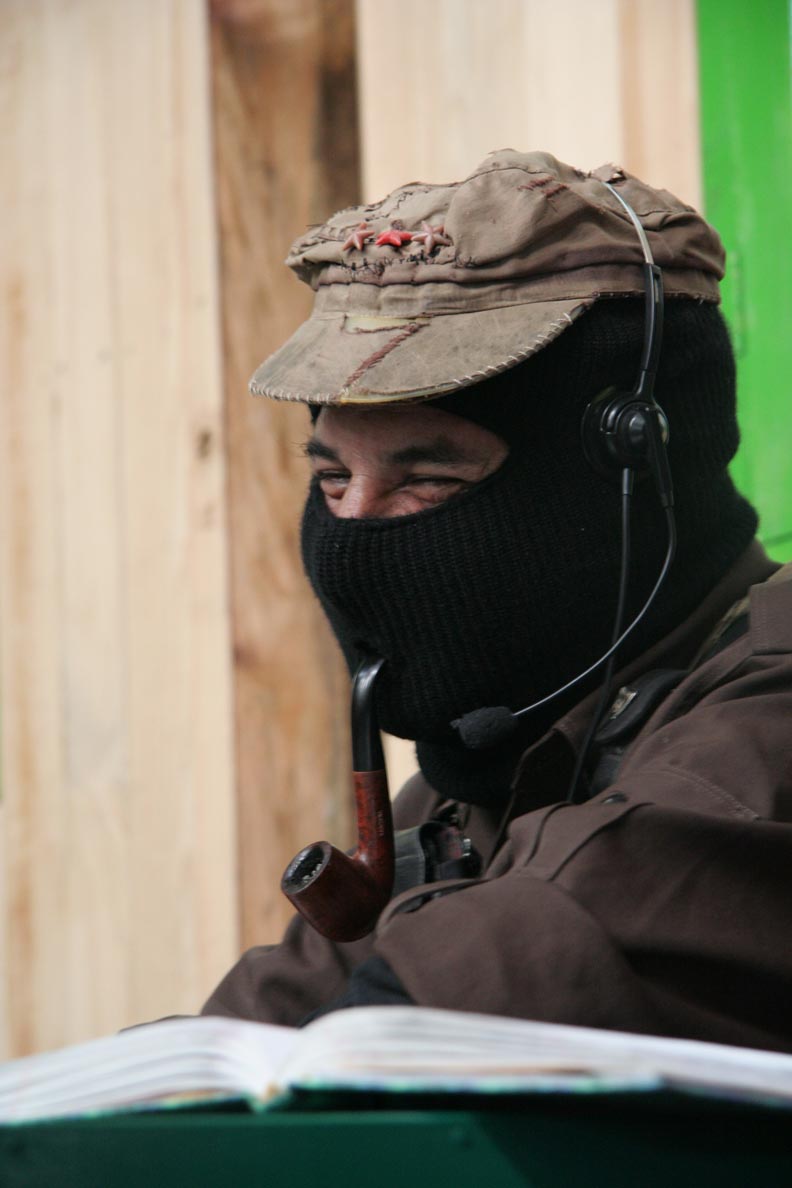 [Photo: Sub-comandante Marcos, smiling]
I didn’t know the existence of this sort of binnacle of flight or campaign diary in which, paradoxically, Elías Contreras did not write anything directly related to that case in which love, this other kind of love, came to him as it usually comes, that is, through the most unexpected way; in his case, it came accompanied by the confusion and fear that usually accompanies meeting with the other. That love which went the way one fears the most: through the irremediable route of death. Because, perhaps someone remembers it, La Magdalena died fighting on our side, the Zapatista side, against Evil and the Villain. And she, La Magdalena, was our companion twice over: because she chose to be a woman and because she chose to be it with us. But this is another story that maybe we’ll find somewhere else.
Elías Contreras never said that he fell in love with La Magdalena, the transvestite who saved his life in the streets of Mexico City and who accompanied him in the pursuit of Morales. He never expressed it openly, it is true; but anyone who learns to listen to words, silences, gestures and manners, can also find even unsuspected secrets. And Elías Contreras, EZLN’s commissioner of investigation, used to talk about La Magdalena by keeping silent about her, as if words could hurt her. I believe, and this is something I’m thinking now, that Elías Contreras was not corresponded with the same sentiments that he held for La Magdalena and that in some way, it relieved him of the disorder that this emotion was causing him.
But in due time I perhaps will tell you about the now deceased Elías Contreras’ secret love for La Magdalena as well as about what he had in his notebook. Or perhaps I will never tell you, because there are persons who not only leave us upon dying, as a weight, the manifestation of their death: they also leave us the secrets of their life.
Now I want to tell you about some parts of Elías Contreras’ notebook. Many times dawn surprised us standing in front of his kitchen burner and, when our silences were sufficiently long, Elías used to pick up the worn notebook from his haversack and pass it to me without either looking at me or saying a word.
I used to glance at it as an awkward intruder. It was enough to give it a rapid look to realize that only its author might decipher what was written or drawn there. As if it were a puzzle whose complete figure everybody ignores except the one who designed the pieces.
Sometimes I read some phrase aloud and he, Elías Contreras, started to assemble the pieces. As if speaking to himself he replayed an anecdote or an argument.
There was, for example, that simple and concise ethics of the warrior who, in almost illegible strokes, Elías Contreras must have copied somewhere:
- The warrior must be always at the service of a noble cause.
- The warrior must be always prepared to learn and to be a warrior).
- The warrior must respect his ancestors and revere their memory.
- The warrior must exist for the well-being of mankind, that for which he lives, that for which he dies.
- The warrior must cultivate science and arts and, with them, to be also the guardian of his people.
- The warrior must equally devote himself to both big and small things.
- The warrior must see ahead, to imagine a complete and finished totality.
One evening, this time not at dawn, while we watched the sun jumping from cloud to cloud before hiding behind the mountain, with his notebook in my hands I read for him the following phrases he had written: “Resistance means to stop the destiny imposed from above, just the time needed to acquire strength and then destroy both this misfortune and the people who cause it.”
Upon listening to it, Elías Contreras said: "Guadalajara, when the Russian and the Chinaman…" And forthwith he told me that he wrote this thought at dawn while he was waiting in the "Western Pearl’s downtown."
It was followed by another phrase. I read it aloud: "The big heads who sell out for money lack intelligence, as they also lack courage, shame and good manners. As the citizens say: they are mediocre, cowards, stupid and bad mannered".
"Up there", Elías Contreras said to me looking bitterly down, "not only did they invent a religion where only the one who has counts, not the one who is. Some also do as their priests who write and preach the doctrine of the powerful among both the people from above and below. They are like priests but also like policemen, and make sure that we behave ourselves well, that we accept exploitation and act docile, nodding ‘yes’ or ‘no’ with our head according to the order we’re given. So the powerful also screw you in your thought. And these thought priests of the people from above are the big heads who sellout for money."
"You mean the intellectuals from above?" I asked.
"Those," said Elías Contreras, EZLN’s commissioner of investigation. And sitting on a log, looking westwards, he repeated for me the argument he constructed here in Guadalajara, while he was following both Evil and the Villain’s track in this still incomplete task of us, the so called neo-Zapatistas.
From this argument, which Elías Contreras exposed for me in Tzeltal language and which, therefore, has words for which there is no equivalent in any dictionary of the domineering and dominating languages, I extracted the following notes:
THE INTELLECTUALS FROM ABOVE
If police and the armies are the captains of citizens’ good behavior vs. spoliation, exploitation and racism, who checks after the good behavior in intellectual reflection, in theoretical analysis?
If the juridical system which covers with a "rational and human" dressing the violent imposition of capital has judges, watchmen, policemen and jails, who are their cultural equivalent in Mexico, in research and academy, in theoretical production, analysis and debate of ideas?
Response: the intellectuals from above, who say what is science and what is not, what is serious and what is not, what is debate and what is not, what is real and what is false, in sum: what is intelligent and what is not.
Not only capitalism recruits its intellectuals in the academy and in culture, but it also “manufactures” its resonance boxes and assigns them their territories. But what makes them similar rests upon their common foundation: they simulate humanism where there is only thirst of earnings, they present capital as the synthesis of historic evolution and they offer the comfort of complicity via scholarships, advertising payments and privileged dialogue. There is no valuable difference between a book of personal betterment and the "Free Letters", "Nexos", "¿Quién?" and "TV y Novelas" magazines. And this neither in the editorial staff nor in their price or in the place they occupy in Carlos Slim Helú’s Sanborns, or perhaps their only difference is that the last two sell more and are more widely read. What about their content? They all offer the impossible mirror where the ones from above are who they are.
THE INTELLECTUALS FROM THE MIDDLE
As it happens in the impossible center of the impossible geometry of Power, the intellectuals are in the fragile towers of crystal of "neutrality" and "objectivity" that sail flirting either discreetly or shamelessly with the system, no matter who the people who control the political power are.
By looking up, these intellectuals answer to the explicit or implicit question with which their work starts: "From where?" And in this question other questions get tied up: "Why?", "With whom?", "Against whom?"
From the antechamber of Power, doing merits in the court of the fashionable six-year period top position, these intellectuals are not in the middle, but on their way up. In the benches of Mexico's political and economic power, they show their predisposition to use the tools of analysis and theoretical debate with a sign that says: "We write speeches. We justify governmental programs. We advise businessmen. We publish anything you like. We entertain parties, shareholders' meetings and offices".
Along with these intellectuals there are those who, either slowly or rapidly, betrayed their principles, gave in and are looking desperately for an alibi that saves them in front of the mirror. They are prudent, mature and sensible intellectuals who have laid down the weapon of critique under the caresses of the ones who dress their rightwing task with leftwing clothes.
But the dishonest position of these intellectuals sympathetic to the system is disconcerting. The poor alibi of slow, rational and responsible change cannot sanctify this cave of thieves of the self-named electoral left. They dress with the fragile fleetingness of mass media, and with it they disguise not only their inconsistencies, but also their resignation to any exercise of critical analysis of the political class. Harassed by the ghosts created by their prudence, they ratify a deep scorn for intelligence.
Some of them even call themselves radical left and even Zapatistas (surely in the same manner in that Guajardo called himself Zapatista2). From the comfort of academy they set themselves up as the new judges, the neo captains of good manners in the debate on what the AMLO’s irresistible ascent really means in the democratic modernity, that is, in the surveys3.
They are the ones who say that any critique of the political class helps to promote abstentionism and, with Thomist logic, to favor right-wingers. They are those who select and edit the national reality to present the unpresentable. They are those who keep silent before the treatment that the municipal Perredista president of Tulancingo (Hidalgo state) grants to Indians and elders4; before the frantic jump of both the PAN and the PRI into the open arms of the PRD in any place of the nation; before the nepotism of the Tabasco’s Perredista chapters5; before the sale of their franchise to the local party boss in shift of any state; before the approval of destructive neoliberal laws on the benches of the Aztec Sun; before the suspicious similarity in names and surnames on the lists of Perredista candidacies with the previous ones of the PRI and PAN parties.
They are the same who want us to swallow the millstone of supporting the macroeconomic project while at the same time macro politics is changed.
They are the same who sell the illustrated resignation from door to door: the only comfortable option is the less villain of them all.
They are the same who say without any embarrassment that the government protects the Other Campaign in order to attack López Obrador6, while the cops photograph, monitor and scourge the Karavana’s members, the state, regional and local coordinators. The same ones who feel a deep scorn for their readers and who, without any shame, one day tell them that Rosario Robles is a heroine and the day after they don’t even remember her7.
They are the same who discredited the young CGH students who in 1999-2000 managed with their movement9, against everything, to maintain the UNAM as a public and free university; the same ones who silently applauded the repression to the young anti-globalizers on that shame of the Jalisco calendar that is the 28th of May, 2004.
They are the same who sigh with delight for the second floors, the bullet train, the Transistmic Project8, the co-investments in PEMEX and the electrical industry, the entry of Mexico to the baseball major leagues’ circuit, the concerts in Mexico City’s Zócalo, the privilege of dialogue with the authorities.
Ah! At least a good scenery from the second floor in order not to see - or to pretend not to see - the people from below, the provocative, the accelerated, the ear ringers, the punk hairs, the rebellious, the plebeians, the damned, the lower classes.
Who cares if they are the same in the above up politics and if it is the same "macroeconomic" program of yesterday? Who cares about these trifles? Who worries because this program represents the continuation and deepening of the Mexican Nation’s destruction?
They are the same who offer the calamity of not conforming with what exists, man, but don't be very demanding either, man, because if Madrazo or if Calderón, if the PRI or the PAN, tell me, what will the foreign nations say? Concerning the big investors, man, well, those have already understood, now it is necessary that the people from below understand and obey. But everything is tied up, man, we will make it, man. Now it is our turn. An advisory post, trips, food, we will hobnob with the crème de la crème.
They are the ones who never quite succeed, who must face the promise written in Guanajuato: “There still are many public things to do”. They are those of fragile skin that crack on the first critique and shout their head off distributing labels of "intolerant", "Stalinist", "ultra", "“outdated", "immature".
The intellectuals from the middle… Where the Other Campaign says "wake up", these intellectuals say, beg, request, implore: "Remain asleep".
THE OTHER INTELLECTUALS
From below and from the left side, a movement that is constructing itself, the Other one, also constructs new realities. We the neo-Zapatistas think that these new realities that are already arising and that will be appearing hereinafter, need another theoretical reflection, another debate of ideas.
This requires from the other intellectuals first humility to recognize that we are facing something new; and second to join, to make the Other their own, to know as part of one another the Indian, the worker, the peasant, the youngster, the woman, the child, the elder, the teacher, the student, the employee, the homosexual, lesbian and transsexual, the sexual worker, the traveling vendor, the small merchant, the grassroot Christian, the street worker, the other.
We think that they should take part in the adhesion meetings in their states and, besides, they should listen to everything all new members say in the entire country. Thanks to the alternative media, the other media, it is possible to follow closely this beautiful lesson of national contemporary history. In their milieu and with their way of doing things, surely the other intellectuals will produce analysis and theoretical debates that will amaze the world.
As Zapatistas we think that the Other Campaign can proudly say that it deserves the best intellectuals of this country who are part of it; it is now up to them to say, with their own work, if they themselves deserve the Other Campaign.
THE MISSING WORD
In EZLN's commissioner of investigation Elías Contreras's old and worn notebook there is a loose and carefully folded sheet where one can read: "There are stones that still keep silent. When they speak the secrets they guard, nothing will be the same, but for sure it will be better for all. Being, not having, will be what counts. Another hand will raise the flag and the world will smell, be heard and feel as it must be: The honorable house of the ones who work on it."
ANOTHER CANDLE FOR SHADE
Dawn. Above the sky the moon continues its impudent undressing of the blue light that covers it. Darkness excuses its scars and offers her, generously, another veil for its indecency. Down here shade huddles in the last corner of its sleeplessness.
That which is rising up, is it a wind or a bridge looking ahead for another shore to end rest upon?
A sigh, maybe.
And then again the light sleep and its illusions: a sighed serpentine tied in an absent neck, anxiety getting up and sinking in the lower abdomen, the slight breath of shade on the ear of night, desire dressing up the brown light of semidarkness, a long and wet kiss on other lips, the hand writing a letter that will never reach its destination: "I would give anything to get entangled between her legs, to confuse our dampness, to waste myself out on the cleft moon of her hips. I would give anything, except to stop doing what it is my duty to do."
Daybreak. The sun starts helping houses and buildings on their languid leaning down to the West.
The other Jalisco sharpens the word and sharpens the ear.
Outside, they ask: “Ready?”
Inside, the shade folds anxiety carefully, places it in the shirt’s left pocket, near the heart, and answers: "Always."
From the other Guadalajara,
Subcommander Insurgent Marcos, Mexico, March, 2006.
NOTES BY THE TRANSLATOR
[1] Tapatía: This word of Aztec origin (tlapatiotl, the price paid for anything that is bought) designates all people and things related to the city of Guadalajara, in the Mexican state of Jalisco.
[2] Jesús M. Guajardo, a traitor during the Mexican revolution who killed Emiliano Zapata.
[3] AMLO, Andrés Manuel López Obrador, ex-major of Mexico City and presidential candidate in the next elections.
[4] Perredista, any member of the Partido de la Revolución Democrática (PRD), López Obrador’s party.
[5] PAN, PRI, PRD: the three main Mexican parties, Partido Acción Nacional, Partido Revolucionario Institucionalizado, Partido de la Revolución Democrática.
[6] Last year the Zapatistas made public the Sixth Declaration of the Lacandon Jungle in which they outlined a different strategy in their organizing, one in which they would continue to fight for indigenous rights, but also include other marginalized sectors of Mexican society—with the hopes of working together towards the creation of a national front against neoliberalism. The EZLN made the call to initiate The Other Campaign in Mexico as a grassroots effort of putting into practice the alternative way of doing politics between organizations and individuals of the Left. The Other Campaign begins with a Basis of Unity of practicing a different way of doing politics that is anti-neoliberal, anti-capitalist and Leftist. It proposes the construction of a Leftist plan of struggle and creation of an alternative to neoliberalism in Mexico, as well as a new Constitution. The EZLN and the Other Campaign attempt to unify the struggles from the city and countryside, as well as between indigenous and non-indigenous people. See: Gloria and Jacobo - Mexican Political Prisoners ... (wait for search engine).
[7] Information on Rosario Robles
[8] A road and railway transistmic corridor that will connect the Istmuth of Tehuantepec from the Pacific Ocean and the Mexican Gulf. All the indigenous communities are going suffer from this project.
[9] CGH, Consejo General de Huelga. In English, General Council of Strikes.
Original Graphic for Axis of Logic by JUAN KALVELLIDO

*Translated from REBELIÓN by Manuel Talens and revised by Mary Rizzo, both members of Tlaxcala (www.tlaxcala.es), the network of translators for linguistic diversity. Juan Kalvellido is also a member of Tlaxcala. Read more about Tlaxcala!
© Copyright 2006 by AxisofLogic.com(translation copyright)
Additional Reading on Sub-comandante Marcos and the Zapatista National Liberation Army
Is Islamism soluble in Zapatism? Muslims, try to become Zapatista! WHAT IF SUBCOMMANDER MARCOS WAS MEHDI'S INCARNATION?
A Night With Subcomandante Marcos
Zapatistas in Zirahuén: "They fight united and fight well, for their land, for their forests, and for their lake, too"
In Querétaro, the Zapatista “Other Campaign” Picks Up the Hammer of the Urban Worker
Former Braceros and Zapatistas Unite to End the System that Beats Them Down
Mexico Braces for Next Move by Elusive Leader of Zapatista Rebels
Maquila Violence in Mexico. The Other Campaign at Mexico's internal border
Mexico: The False Narco-Smear Against the Zapatistas
Zapatistas sound a ‘red alert’ as troops move into Chiapas





 Print This
  Print This