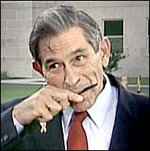
 Paul Wolfowitz, master mind of the Iraq War, left his post as U.S. Deputy Defense Secretary, after he got the destruction of Iraq that he and his Ziocon conspirators wanted. Bush then handed him the job of president of the World Bank where he and others thought he would advance the bank's debt and exploitation of the third world. But a man who cannot control his own sex urges cannot be expected manage the coffers of the Global Corporate Empire. His "resignation" and the chaotic struggle within the World Bank comes as one more piece of evidence that the empire is in crisis.
The hatred his World Bank colleagues quickly developed for him turned into an internicine, capitalist battle that left Wolfowitz vulnerable. When he was first trapped with his corruption, he pouted, a pathetic sullen figure - complaining that a "smear campaign" was being executed against him. Then he turned rabid against his colleagues at the World Bank, "If they fuck with me or Shaha, I have enough on them to fuck them too." Finally, today, he was cornered and this Bush-backed rat caved in and resigned. Bush was quoted in the news today saying, "I'm sorry it turned out this way".
Tonight, U.S. Treasury Secretary Henry Paulson attempted to defend him on the PBS Jim Lehrer show. A stumbling, fumbling Paulson side-stepped every question asked him by Jim Lehrer, knowing full-well that Wolfowitz stood naked and without a credible defense. In a last desperate attempt to salvage something-Wolfowitz, Paulson told Lehrer that Wolfowitz "planted seeds" in Africa that will bear fruit in the future, attempting to depict him as a humanitarian. If Paul Wolfowitz planted any seeds in Africa during his brief tenure, they will only produce more enslaving third-world debt for which the Bank is now well-known.
In his career death-throes, Wolfowitz used the U.S. government to leverage a few face-saving words on his behalf and no doubt he will leave with money in his pocket. But Paul Wolfowitz will always be known for the millions of lives he has destroyed in Iraq and the destruction he has wrought in the Middle East and throughout the world. He thought his escape from the Iraqi War was clean, leaving the failure in the lap of George Walker Bush. But oh how the mighty are fallen. We share the knowledge with millions of others that the natural order of things and the new world revolution has brought down this enemy of the people. But the real reason Wolfowitz was canned is much deeper than his tawdry sex life. One has to look at the corruption and international exploitation of the World Bank to understand. - Les Blough, Editor
Wolfowitz Quits World Bank Over Promotion for [Sex] Partner
by William McQuillen and Christopher Swann
May 17 (Bloomberg) -- World Bank President Paul Wolfowitz quit today less than halfway into his five-year term, bowing to an international furor sparked by his involvement in a pay raise for his companion.
``I have concluded that it is in the best interests of those whom this institution serves for that mission to be carried forward under new leadership,'' Wolfowitz, the former U.S. deputy defense secretary and Iraq war architect, said in a statement in Washington. His departure is effective June 30.
Wolfowitz, 63, faced rising calls to leave from donor governments and staff members, who said he had hobbled the credibility of the world's largest development institution just as it geared up to raise $28 billion in fresh funds. He leaves a bank bruised by battles over his choice of advisers, a campaign against corruption and the bank's role in Iraq.
``There's no way he could have remained an effective leader because of the acrimony and rancor,'' said George Ayittey, an economist at American University in Washington and a former World Bank consultant. ``There was too much animosity within the bank.''
Wolfowitz was the first president to resign under fire since the group was founded in 1944. President George W. Bush, the only world leader to say he should stay in office, yielded to pressure from European nations including France, Germany, the U.K. and the Netherlands.
Focus on Africa
Admirers praised Wolfowitz's devotion to helping the poor. Wolfowitz ``has shown a strong will to help Africa,'' Burundi's finance minister, Denise Sinankwa, said in an interview on May 15. ``I feel sorry for what has happened.''
His departure raises fresh questions about the process of selecting the World Bank president, who by tradition is chosen by the White House, while the leader of the International Monetary Fund has always been a European. Some critics have called on the bank to adopt a merit-based selection process.
``The mechanism for choosing the head of the World Bank is badly flawed,'' said Joseph Stiglitz, a professor of economics at Columbia University in New York and a former chief economist for the bank. ``It is particularly bad when the World Bank is trying to convey a message of good governance around the world.''
White House spokesman Tony Fratto said that Bush would name a replacement ``soon.''
Possible Successors
World Bank watchers say possible successors include Robert Zoellick, the former U.S. trade representative who is now a Goldman Sachs Group Inc. executive; Allan Hubbard, director of the White House National Economic Council; and even Treasury Secretary Henry Paulson.
Wolfowitz resigned after three days of negotiations with the bank's directors yielded a compromise that allowed him to avoid sole responsibility for his involvement in a pay-and- promotion package for his companion, Shaha Riza.
``He assured us that he acted ethically and in good faith in what he believed were the best interests of the institution, and we accept that,'' the directors said in a statement.
A panel of seven directors on May 6 told Wolfowitz that he had violated staff rules and his employment contract when he dictated the terms of a 36 percent pay increase for Riza, along with guarantees of further 8 percent annual increases. The panel, in its report, told the full 24-member board that the bank's reputation had been damaged and the board should consider firing him.
Good Faith Effort
Wolfowitz argued that the package represented a good-faith effort to carry out the instructions of the bank's ethics committee, and that the bank should bear some of the responsibility. That was an argument that the board accepted today, saying that ``mistakes were made by a number of individuals in handling the matter.''
Wolfowitz initially apologized for the scandal, which overshadowed last month's twice-yearly meeting of the World Bank's 185 members in Washington. He later adopted a more belligerent tone, hiring attorney Robert Bennett to represent him and saying he was the victim of a ``smear campaign.''
``In the end, it seems that Wolfowitz got most of what he wanted and the bank ate humble pie,'' said Dennis de Tray, a former World Bank director and now vice president at the Center for Global Development in Washington.
Iraq Role
Even before the controversy erupted in April, Wolfowitz aroused hostility by pushing aside senior managers in favor of advisers recruited from the Bush administration. His proposal to beef up the bank's presence in Iraq exposed him to charges he was using the World Bank to further U.S. foreign policy goals.
Wolfowitz on May 15 appeared before the board and delivered a final plea to keep his job. He conceded he had relied ``much too long'' on advisers brought in from the White House and promised to put more trust in bank vice presidents.
``It is quite apparent that this matter has ceased to have much to do with the case itself -- and everything to do with issues about my management style and my policy choices,'' he said.
Wolfowitz, a former political science professor who also worked for Presidents Ronald Reagan and George H.W. Bush as a diplomat and policy maker, came to the World Bank bearing the baggage of his role in the Iraq conflict. He was often heckled by anti-war protesters during trips around the U.S. and abroad.
``For those who disagree with the things that they associate me with in my previous job, I'm not in my previous job,'' Wolfowitz said in an April 12 statement. ``I'm not working for the U.S. government.''
Aid Suspended
His anti-graft campaign also ruffled feathers. Wolfowitz failed to consult bank directors when he suspended loans to Chad, Kenya, India and Bangladesh in his drive to ensure aid money didn't line the pockets of corrupt politicians.
A former professor of political science at Yale, he served as ambassador to Indonesia and assistant secretary of state for East Asian and Pacific Affairs in the 1980s.
Yet he had scant experience running large organizations, unlike predecessors such as James Wolfensohn, a former Salomon Brothers executive, and Robert McNamara, the Vietnam-war era defense secretary and one-time president of Ford Motor Co.
To contact the reporters on this story: William McQuillen in Washington at bmcquillen@bloomberg.net ;