The long suspected links between “respectable” politicians in Colombia and right wing paramilitary forces has finally had the lid blown of it in the last two months. The former Colombian Foreign Minister, María Consuelo Araújo, was pressured into resigning in February after an arrest warrant was issued against her brother Alvaro, a Colombian Senator. He is being charged with alleged links to the United Autodefense Forces of Colombia (AUC), a Colombian paramilitary organization.
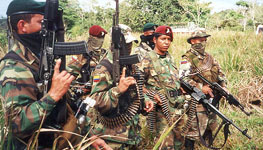 |
| Paramilitaries are responsible for more than 70 percent of the human rights abuses in Colombia. Photo: Garry Leech |
Other congressmen under investigation and currently held in custody are Miguel De la Espriella of the Democratic Colombia Party; William Montes, of the Colombian Conservative Party; Reginaldo Montes of the Radical Change Party. The list continues with the Senador Juan Manuel López Cabrales of the Liberal Party and congressman José de los Santos Negrete of the Colombian Conservative Party.
Latest news indicates that the Colombian Attorney General has issued arrest warrants for nine mayors in the Casanare oil producing region. It started when the computer of paramilitary commander Rodrigo Tovar Pupo, alias ‘Jorge 40’, fell into the hands of authorities. Then, at the end of last year, revelations made by Miguel Alfonso De la Espriella, Senator from Córdoba that a “pact” had been signed with the government-backed paramilitaries as far back as February 2001. [1] The scandal has resulted in:
50 politicians behind bars, including 15 congressmen, one Departmental Governor, 9 mayors some of whom were sharing their municipal budgets with the AUC, an undefined number of ex parliamentarians, town councilors, as well as the senators mentioned above.
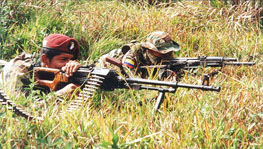 |
| The AUC works closely with the Colombian army in its war against the guerrillas. Photo: Garry Leech |
To make matters worse CIA declassified documents [2] indicate that Colombian army chief, General Mario Montoya, has also been consorting with the AUC , a charge which he strenuously denied. At the same time, Colombian President Alvaro Uribe Vélez has been accused of “working for late drug lord” Pablo Escobar while in the US in the early 1990’s. [3]
Ex head of the Colombian Security Services (DAS), Jorge Noguera, has also been accused of selling secret information to the AUC and plotting to assassinate Venezuelan President, Hugo Chávez. He is currently out of prison on bail. [4]
In another twist, reports have surfaced that Interpol is on the heels of three Israelis, [5]presumably MOSSAD agents, who had allegedly been training AUC peasant militias in the 1990’s, after an arrest warrant was issued for their capture by the High Court of Manizales Department. The Israelis concerned are Yair Klein, Melnik Ferry and Tzedaka Abraham. Klein had already served jail time in Israel for supplying arms to the AUC in Colombia in 1991.
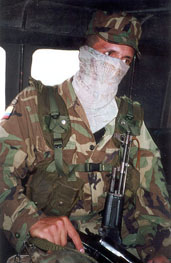 |
| Many paramilitaries are former soldiers from the Colombian army. Photo: Garry Leech |
It is well known that in so-called “Plan Colombia” the U.S. has been providing the Colombian military with “military advisors”, arms, patrol boats and helicopters for years. Plan Colombia is supposedly aimed at eliminating coca plantations and curbing drug running at the source of production to reduce drug shipments to the world’s biggest consumer the US. The results of Plan Colombia has been poor with more acres of coca under production than ever before despite spraying illicit plantations with Monsanto chemicals deemed illegal in the US and Europe. Plan Colombia allows covert US military operations in the region which is also a beachhead for destabilization of the Andean region and probably the whole of South America long term as the US imperial ambitions are directed at Amazonas and its natural resources such as lumber, oil and more importantly water.
However, a new scandal [6] has developed involving a US multinational providing arms to the paramilitaries of the AUC. Chiquita Brands, formerly United Fruit Company, is under investigation for supplying 3400 AK 47’s and five million of rounds of ammunition to the AUC, specifically to paramilitary commanders Vicente and Carlos Castaño. paramilitary commanders Vicente and Carlos Castaño.
These arms were diverted from Nicaragua’s armed forces in November 2001. Chiquita only received a financial slap on the wrist by of US$ 25 million by the US Government for consorting with the AUC, considered a terrorist grouping by the US State Department.
Since then it has been revealed that Chiquita Brands paid millions of dollars to the AUC to “protect” their employees in the Colombian banana plantations. In reality it was to keep them “under control” and break any attempts at unionization. AUC methods of “control” are simply based on eliminating “difficult employees and workers”.
There certainly does appear to be something “rotten in the Republic of Colombia”, to paraphrase Shakespeare’s Hamlet.
Unraveling this political Gordian Knot
President Uribe did not waste time in hitting the ball back into the opposition’s court when he asked them to provide evidence of his links with the AUC back in November last year [7]
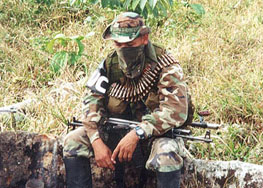 |
| The AUC receives funding from the drug trade, large landowners and wealthy businessmen. Photo: Garry Leech |
In relation to the Chiquita Brands scandal he has asked for US executives involved in paying the AUC as “controllers or protectors” - to be extradited to Colombia to stand trial. Colombia has extradited almost 100 drug runners to stand trial in US in the last 10 years, and is mistakenly expecting the US to play the extradition game on a level playing field. This is highly unlikely since the US has consistently refused to hand over anti-Venezuelan terrorists to Caracas despite repeated requests from the Chávez government and Foreign Ministry.
The highly publicized demobilization of the AUC by the Uribe government since 2005 as part of the Colombian peace process has been met with much skepticism. For laying down their arms, the militias were granted amnesty for the massacres and crimes committed. Many were reportedly funded by the Colombian government to become “farmers” near the Venezuelan border. Questions: Why locate them near the Venezuelan border? Are we to believe they are now unarmed? Other AUC members who were “demobilized” formed new paramilitary groups in other parts of the country, paid by landowners and drug traffickers. [8] In other words, the demobilization was likely a public relations mirage leaving the farmers and the land on which they lived under the mercy and control of unscrupulous landowners. There is still a steady flow of displaced people to the main cities from the countryside even in 2007.
Three states in one…or even four
Colombia is controlled by the official government, the AUC, the revolutionary Armed Forces of Colombia (FARC) which is said to control 40% of the country outside the cities, and the National Liberation Army (ELN) active in the north east of Colombia.
This situation of civil war is more than half a century old and despite attempts to construct a peace process, all initiatives have ended in failure. The Colombian government is negotiating with the ELN in Havana, but after three meetings, little progress has been made.
The oligarchy’s grip on power has not been weakened despite the on-going internal conflict and with a regime of terror, massacres and displacements accompanied by the wholesale murder of unionists and local organizers. There is no end in sight to this civil war.
On the other hand traditional politics has taken a real hit after the involvement of government and regional politicians with the AUC militias has finally come to light. Could this alter the landscape of Colombian politics and initiate a power shift?
Difficult questions
Will these developments make the Colombian middle classes realize that many of their elected officials are just gangsters connected to armed criminal, drug runners, terrorists, murders and mafiosos? Will this change voting patterns? Will Colombian public opinion shift and conclude that on one side of the divide is organized state terrorism directed against its own people, and on the other side the formation of some guerrilla armies struggling against the historical murder and land grabbing from the population itself? Will this allow new leaders to emerge, even on a regional level to fill this breach?
The only recent example [9] of a new political force emerging was in late 1985 when the Patriotic Union was formed from the Colombian Communist Party and the FARC to participate in the democratic process. After receiving a modest 5% of the vote in the 1986 elections, the result was that between 3000 and 5000 members of the Patriotic Union were subsequently assassinated, allegedly by the AUC, and so far, no one has been even sent to stand trial. It is strange that President Uribe has not ordered a judicial or independent inquiry into the penetration of the national and regional governments by the paramilitarismo. Would this not be the norm in most other countries?
This is the fear which stalks many politicians who want to change the system, even democratically, in Colombia but few see any resolution of this internal conflict for many years to come. It’s just not possible to change the culture of political violence in a country which has been at war with itself since 1830 peppered by extremely bloody civil wars – the Thousand Day War from 1899-1902 and then La Violencia from 1948-1958 after the assassination of Jorge Eliécer Gaitán [10] a period in which hundreds of thousands of innocents were slaughtered.
This is without mentioning the current war started in the 1960’s which does not indicate any break in this cycle of unprecedented violence and state sponsored terrorism.
On the other hand, the Uribe government is in crisis as their imperialist master finds his handiwork coming to naught and his armies defeated on many fronts throughout the empire. As the people of
- El Heraldo
- Axis of Logic
- Axis of Logic
- El Tiempo
- Axis of Logic
- La Prensa
Irenees - Wikipedia
- Wikipedia (2)
- Wikipedia (3)
- Wikipedia (4)
- Colombia Journal
Additional reading:
Crude Interventions: The United States, Oil and the New World (Dis)Order