The Revolution Must be Intensified!
Orlando Chirino is the national coordinator of the new Venezuelan workers’ union UNT, a member of its classist trend, and also leader of the Committee to Promote the Construction of the Revolution and Socialism Party, which is currently being formed in Venezuela.
Franck Gaudichaud: A few weeks ago, the sixth World Social Forum (WSF) was concluded. A part of this polycentric WSF was held for the first time in Caracas, Venezuela’s capital: What did this international, alternative-world conference mean for you, where more than 70,000 people were present, from all around the world and all of Latin America?
Orlando Chirino: For us it’s a question of an important occasion when we can share with delegates from all over the world and get acquainted with the political and labour movement situation in various countries. That’s why we value the forum and that’s the reason why we take part in all the forums. It’s very positive, but there are still many structural difficulties too, like the fact that it’s always hard to find, agree on, and vote on policies together. It’s true that very different organisations make up the WSF and therefore it’s complicated to seek specific points and tasks in common.
In the case of the Caracas forum, there was also a low level of participation by Venezuelan organisations, and that explains why the foreign delegates had to go to the factories and barrios, in order to be able to learn about the reality of the Bolivarian process. You have to add the fact that we, the UNT activists, weren’t invited to the forum, we were excluded, even if independently of the organisers, we participated in some discussion sessions. There was also a lack of mass participation by Venezuelans. It seems to me that many comrades who work at the grassroots level don’t know the meaning and the importance of the forum well, and the people in the street know even less: they didn’t feel that the forum was theirs... I think that there wasn’t enough information here, in Venezuela, and a certain fear, on the part of the organising committee and of a sector of the government, of opening up the forum more broadly. So that I think that we have to recognise everything that’s good, but also to know how to strike a critical, and self-critical, balance.
FG: Currently the discussion in Venezuela about socialism is very present in all areas: President Chávez cites both Karl Marx and Bolívar, he talks about 21st century socialism, participatory democracy, the break with capitalism… according to your analysis – as a social leader but also as a revolutionary activist – what’s the present state of the Bolivarian process?
OC: In the first place, today Venezuela is provided with a government that’s independent and autonomous in relation to imperialism. In the second place, its constitution, which was approved by the Venezuelan people, is an important advance for a process of transition toward socialism, thanks to a new autonomy of powers, numerous victories in terms of human rights, the new freedom for trade unions, the increased number of social missions with the creation of free community clinics (“Mission Inside the Barrio”), with the literacy campaign among the poor (“Mission Robinson”)... In short, there are various victories that are very important.
But we’re still inside a capitalist framework, where private property is respected and where most of the means of production remain in private hands, as is the case with the large banks, which earn fantastic sums based on operations on the order of financial speculation. Because of that, at the trade-union level, we’re demanding participation in the activity. Nevertheless, we’re not even getting involved at the bottom, we’re demanding direct control of the utilities and the property. At this level, it can be said that there’s a “confrontation” between a democratic government that respects private property and us, who are planning a profound change in the relations of production. But in relation to the previous governments, the Bolivarian government is deeply democratic and the most progressive of all.
As the president says, this country is sovereign because it takes decisions, and this is an essential victory. The majority of workers and the popular sectors still strongly support President Chávez and the process. At the same time, the result of the most recent legislative elections, some trade union by-elections, or disturbances in the barrios express the fact that we’re seeing a kind of decline after 7 years of government. The workers are starting to demand more. There are enormous expectations, for example, in the area of the control of production, especially in the companies where the work is more insecure. But let’s say that there’s a certain uneasiness among the people and some anxieties, parallel to the popular support for the government.
In recent years, mobilising the people made it possible to defeat the opposition and the bourgeoisie. At present, there are three essential elements in the national debate. First, the process of growing bureaucratisation which the country recognises, and the anti-trade union practices; in the second place, corruption; and in third place, the conservative posture of some ministers, mayors, or governors. All this when we’re in the presidential re-election year! People at the grassroots are demanding more participation and the end of “dedocracy” [1]: the revolution, the process, must be intensified. The two governmental organisations, PODEMOS and the MVR are very bureaucratised and their leaders are the new rich of this country. In spite of this and these conflicts, we’re fighting for the re-election of President Chávez, which is an important part of this struggle. It’s still necessary to keep up support and struggle to maintain Hugo Chávez as president in order to guarantee the continuity of the process.
FG: When we talk about intensifying the revolutionary process, would that also apply to the “co-participation” in companies and work places?
OC: Yes, we’re demanding the extension of co-participation in the country, merely as a democratic watchword (it’s not a “socialist” slogan). But it’s very important that there be worker participation in companies, especially the public enterprises.
Let me tell you that the participation has to do with the present constitution, which is a progressive victory that’s very important in this process, and this raises the subject of the social Treasury control that is opposed to bureaucratisation. And in this sense there were some very valuable experiences, such as in the case of Invepal or Alcasa. But the government started to restrain the co-participation process: above all in the petroleum and electrical sector, arguing that it involves the strategic sectors and that they run the risk of remaining in the hands of the right if co-participation is applied there.
We have a different view. During the last owners’ strike and the oil industry sabotage (in 2002 and January-February 2003), these workers showed that they’re capable of defeating the imperialists’ plans and setting about production work so as to guarantee the country’s energy supply. That’s why we don’t understand now, when the production has been normalised, why there’s no workers’ control (even integrating the users of these public services). We analyse this retreat above all as a political concession to the conservative sectors by the government, and this with arguments like the one that Che Guevara was opposed to workers’ management in Yugoslavia, and others.
In this sense there was a real retreat within the government after these crises. We plan co-participation as a programme for making the transition and raising socialist awareness.
FG: There’s another participatory axis presented by the government as essential for the construction of participatory democracy, which is called here the “nucleus of endogenous development”, it involves cooperatives. Some speak of more than 70,000 in the whole country, although the statistics vary from one ministry to another… Undoubtedly these cooperatives mean the possibility of work and an entry for thousands of people, both in the countryside and in the towns. Nevertheless, and after having talked about this subject with the president’s advisers and workers, it’s not very clear to me that the existing cooperatives are – in the main – viable in the medium term, especially when some of them reproduce forms of hierarchy and exploitation of the labour force opposed to the socialist project.
OC: We, within the UNT, propose that the cooperatives should be able to be complementary. For us, the first instrument of organisation and participation is the trade union. Therefore we’re against a cooperativism that violates the collective negotiations or trade-union law. Many people are using the cooperatives as a form of turning jobs precarious, making them flexible, with subcontracts for a fixed period of time.
Today the majority of cooperatives in the country are involved in this type of relation, where 4 or 5 people are owners of the cooperatives and make contracts with people for a limited time, with low wages and without trade union rights: they’re like “small businesses” ... This obviously contradicts what the government says about the construction of socialism. Actually one sector is in favour of the transformation of the cooperatives into businesses, a phenomenon which is happening in Colombia for example, and which leads to disguising the exploitation of the workforce for the great advantage of the large enterprises which subcontract them as providers of services, without having to go through the rules of collective negotiations and the unions. In addition, it permits them to win the state subventions that are granted to this type of cooperative. What’s certain is that some cooperatives work effectively to solve serious immediate problems, those of the poorest people, such as the cooperatives that serve meals to the poor. These cooperatives are complementary.
But basically we believe that in Venezuela, with all our wealth, it’s possible to create decent and permanent employment, and not these precarious, temporary, and unstable contracts that exist in the cooperatives. This is a debate that’s developing rapidly in the country, in which the UNT is participating. In the end it’s a matter of thinking where the cooperativist movement will be located in a process of constructing a socialist society.
FG: The UNT has announced, after various consultations with its local branches, that it will have its national congress on 30, 31 March and 1 April 2006. What are the challenges and topics that will be discussed on this occasion?
OC: The first challenge will be finally, to make the holding of this national congress a reality. Because during the UNT founding congress, it was agreed to hold elections in order to elect a democratic leadership within the next year and to reform the statutes. And it’s been three years and it still hasn’t been possible to carry out the resolution of the congress: there are tendencies within the UNT that don’t want to submit to a referendum. The reform of the statutes will be designed to radically democratise our organisation, with the aim that elections can be held in May through direct and secret election in all the local organisations. If that happens we’ll be the first workers’ union in the world that will have an executive committee elected in such a way. The second challenge will be to ratify the character of the UNT: autonomous and independent of business, the state and the political parties.
FG: Does that mean that at present that’s not the case?
OC: Yes, but there are strong pressures and there’s a tendency within it [the Bolivarian Workers’ Front – editor’s note] that demands “governmentism”, meaning that they have visions of appendices of the government. It’s necessary to insist on better information at the local level, since the executive committee can’t debate behind closed doors without informing the workers. Also, as regards the collective contracts, these should be prepared through democratic consultation. And one of our greatest challenges as the central is changing the labour code, parallel to reaffirming its internationalist and socialist orientation.
In short, we have to re-discuss our programme: take a position on the country’s internal and external debt and know if we demand a popular referendum in order to abolish it; for the formation of a club of debtors, to hoist the flag of our people’s sovereignty and self-determination, to take a position on the astronomical profits of the bank of Venezuela and the transnationals and to know whether we’ll raise the slogan of nationalisation, etc...
FG: Orlando, you’re also known as a “Trotskyist” political leader, we know that you and other comrades are calling for the formation of a new revolutionary party in Venezuela: can you explain to us in a few words the reasons for this decision?
OC: We’ve been political militants since a very early age. I started as an activist at age 11 and when I was 16, I began a conscientious revolutionary activism, after separating from Democratic Action [2]: at that time I became a “Trotskyist” and I state it straightforwardly. But first and foremost I’ve been a trade union leader in this country, fighting in the trenches, defending the autonomy of the movement and its democracy, like the struggle for socialism. In this process of constructing the Bolivarian revolution and above all, since President Chávez left prison, we’ve shared a lot with him, we talk a great deal, we’re beginning to build a Bolivarian Workers’ Front (FBT), we were founders of the FBT as a front where all the trade union leaders had to come together who identify themselves with President Chávez and with the process.
But the class struggle has been bringing up for discussion among us the programme that we’re defending and today we think it’s a legitimate right to call for the construction of a new revolutionary force. On 9 July last year we set up a sponsoring committee for the construction of a revolutionary party in Venezuela, a workers’ party, called the “Revolution and Socialism Party”. Why? Because we need a revolutionary party, especially when in the FBT, as in the leadership of the three Chavist parties, there are leaders who are curbing the process.
At the grassroots, there’s a strong opposition to the bureaucratisation, the degeneration of these organisations, and the serious corruption of some of their members. As for us, we believe that it’s vital to prevent the loss of the advances that we’ve made, because that means nothing less than also taking care of the lives of many revolutionary leaders of this country, and basically the people of this country, who have devoted themselves, who have gone into the streets to defend the process. With this, I want to emphasise that our victories are not the fruit of the parties who have deputies in the congress.
The party that we want to build won’t be “Trotskyist”, because comrades from different tendencies are joining this party, including the militant fringes, who will separate – in proportion as the class struggle becomes more acute - from parties like PPT, MVR, and PODEMOS. At the same time, and I repeat it here as we have done to political leaders, student and trade union leaders, etc.: we don’t want any kind of self-proclamation, and in this sense, the PRS doesn’t yet exist, it’s not even established.
We’re planning a founding congress for July or August 2006, where we’ll assess whether it’s correct – or not – to proceed further toward creating this party. What we’re very clear about today is that this dynamic of constructing a new revolutionary party is registered as a support to the Bolivarian revolution. For this reason we will give strong support to the re-election of President Chávez in December 2006, an indispensable condition for strengthening the process and intensifying our battle against imperialism.
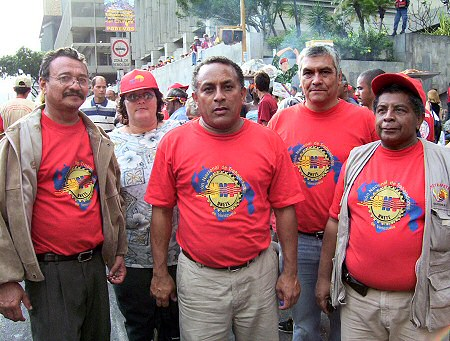
Union activist Francisco Almarza with UNT leaders Marcela Maspero, Stalin Perez, Ruben Linares and Orlando Chirino
Photo: Aporrea.org
NOTES
[1] “Dedocracy” means verticalism and the absence of internal democracy. During the last legislative elections, the leadership of the Chavist parties designated several of their candidates, without previously consulting their activists, which was criticised very extensively within the rank and file of the supporters of the Bolivarian revolution.
[2] Democratic Action (AD): social-democratic party, member of the Socialist International, which shared Venezuelan political power with the Christian socialist party COPEI, since the overthrow of the dictator Marcos Pérez Jiménez (in 1958). For the Venezuelan people, both AD and COPEI represent, in addition to corruption, clientelism, and the servile action of petroleum rentier capitalism.
_____________________
Document: Proposed struggle programme of the Classist, Revolutionary and Autonomous Unitary Trend of the UNTSource: http://www.aporrea.org/
This document was approved by more than 600 trade union leaders from throughout the country, participants in the 1st plenary of the Classist, Revolutionary and Autonomous Unitary Trend of the UNT, held at the Trade Union House of El Paraíso, Caracas, between the 17th and 18th of February 2006.
The proposed programme of struggle
1. To mobilise and organise the workers and the people
- To form a front with all the social sectors in struggle. In such a sense, the trade union leaders who are members of the Classist, Democratic, Sovereign, and Socialist Trend, resolve that the II congress of the UNT shall be changed into a space which brings together the workers, trade unions, the Ezequiel Zamora Peasants’ Front, organised communities, youth and student organisations, indigenous communities, miners, the National Committee for Defence of Revolutionary Co-participation with Workers’ and Social Control, and the National Association of Communitarian, Free, and Alternative Media (ANMCLA), in order to discuss a plan of struggle for the most important claims of all the social sectors.
- Likewise it was planned that a mobilisation of all these sectors at Miraflores would be approved in the UNT Congress. So that we support and join in the initiatives for unitary mobilisation, which the aforementioned organisations are planning, named “Unamos nuestras luchas” [Let’s unite our struggles].
- Solidarity with the workers currently in conflict, emphasising the situation of the workers of Plumrose in the state of Aragua. It was approved that the plenary shall agree on a resolution in support of the workers of Plumrose, Race Droguerías, and Sel-Fex, in Caracas. Likewise it was proposed that in this plenary a strike fund be created, in order to support these workers in conflict.
- General increase in wages and salaries for the 1st of May, Workers’ Day, as well as a mobile wage / salary scale.
- To ratify the need to promote workers’ control and co-participation in public and private enterprises. It was considered that during the strike and sabotage in the petroleum industry, it was confirmed that the workers, together with the organised communities, and the national armed forces, are the only ones capable of defending the country’s basic and strategic industries to the very end, as was demonstrated in PDVSA and in the petrochemical industry.
- To create a social Treasury control office in the cooperatives, which function as businesses and eliminate the participation of the trade unions.
2. For an Alternative Economic and Social Plan discussed with the workers
- Plan for public works and construction of housing in order to confront unemployment and informal structures.
- Promotion of the campaign for Labour Reliability.
- Oil Industry Constituent so that the workers manage our principal industry democratically.
- Re-nationalisation of privatised enterprises, such as Sidor and CANTV
- Nationalisation of the banking system.
- Reform of the labour code, adjusting it to the interests of the workers. To propose the formation of an integrated commission for leaders of the UNT who shall present a suitable project and follow up the national discussion on this topic.
3. Democratisation of the UNT
- Here, unanimously and by acclamation, it was proposed that in order to achieve this it is necessary to hold the congress and the elections now!
- To take up the Mission Cruz Villegas again.
- That within the framework of the workers’ political and ideological education, the UNT develop a national plan for the education and training of the workers and trade union leaders, in order to prepare them to take control directly of the economy and political power in our country, in the context of 21st century socialism as proposed by President Chávez.
- The dates for holding the II congress of the UNT were confirmed: 30, 31 March and 1 April. It was considered very late to hold the elections 90 days after the congress, and it was proposed that this be discussed at the congress.
4. End of impunity
- Punishment and imprisonment for the participants in the coup d’état of 11 April 2002 and the strike and sabotage in the petroleum industry.
- Promotion of the campaign for the lawsuit against the owners of Globovisión for the violation of human rights, in the sense that the Classist Trend agrees to adhere to the habeas corpus lodged against this television broadcaster.
- We will demonstrate our willingness to promote the UNT’s adherence as the country’s top trade union and the participation in bring together firms in support of the judicial action, in the same way as in the mobilisations in order to promote the campaign against the impunity of the coup-makers’ communications media. For the withdrawal of the concessions and for the socialisation of the communications media in the hands of the workers and the people.
5. Against imperialist interference
- Rejection of imperialist aggression.
- Let us mobilise ourselves to denounce the imperialist, anti-worker, and anti-popular policy of aggression. We support the struggle of the peoples and workers of Latin America against the ALCA, the TLC, the Plan Puebla-Panamá, and the Plan Colombia, as well as the just struggle of the COB and the Bolivian workers in defence of the hydrocarbons and their natural resources. In the same way to reject the imperialist invasions of Afghanistan and Iraq. Brazilian and Argentinean troops must get out of Haiti.
- Integration of the workers into the National Reserve and formation of workers’ self-defence brigades, organised autonomously in the trade unions and the UNT.
6. In order to transcend capitalism let us struggle for socialism and the power of the workers without bosses and bureaucrats.
*Franck Gaudichaud (France 1975) is in charge of the
Chili section at www.rebelion.org and has a PhD. in Political Science. He is the author of Poder Popular y Cordones industriales. Testimonios sobre la dinámica del movimiento popular urbano en Chile - 1970-1973 (LOM, Santiago, 2004, www.lom.cl) and Operación Cóndor. Notas sobre el terrorismo de Estado en el Cono Sur (Sepha Ed., Madrid, 2005, www.editorialsepha.com). He belongs to the Editorial Board of the political magazine Dissidences (www.dissidences.net). The reader can contact him at franckgaudichaud@yahoo.es
© Copyright 2006 by AxisofLogic.com(translation copyright)