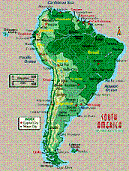
 The Triple Frontier shared by Brazil, Argentina and Paraguay is a strategic military point in South America. At this point in time, the US plan to place advisors there will effectively position the US military within striking distance of the vital oil and gas reserves in the provinces of Santa Cruz and Tarija in Bolivia, and also nearer latent unrest – even civil war as predicted by some observers - in these provinces, if the unilateral secessionist referendums go ahead on August 12th.
Immunity for Crimes Committed by U.S. Military
For more than a year, the US has been exerting economic and diplomatic pressure on South America countries to grant immunity from prosecution to US troops stationed there if any "excesses" are committed such as in Iraq and Afghanistan. US troops are immune from prosecution in Colombia as evidenced by the recent scandal of US military running drugs out of Colombia to the US and not being returned to Colombia to face charges.
The Paraguayan Congress granted immunity to US troops in its territory within the framework of a government to government agreement Military and Bilateral Interchanges and Exercises which was passed on May 5, 2005. THis opened the door to the regionalization of Plan Colombia in the south. This agreement will run from June 1, 2005 to December 31, 2006 and can be extended as was the access of the US military to the Manta base in Ecuador.
Under this agreement US soldiers will virtually hold diplomatic status. They will not be able to be tried for crimes committed in Paraguay and since the US does not recognize the jurisdiction of the International Criminal Court in The Hague, any human rights violations will also go unpunished and extreme cases be dealt with by a "slap on the wrist" in a US military court.
Recently, when Venezuela broke military cooperation ties with the US, a U.S. service woman was apprehended taking photographs of the Libertador air base in Maracay. She was arrested and turned over the US authorities. Chavez then warned that any other US military personnel found committing any other crimes in Venezuela would be tried in a Venezuelan court, and not returned to the US. This was a statement of sovereignty in the face of US intimidation.
External debt used to break down national sovereignty
Even though the Paraguayan government insists that it has only signed a document allowing the free transit of US marines on its territory, one has to wonder exactly how much economic pressure was exerted on Paraguay to take this decision. I suspect that it has to do with the external debt which Paraguay has had difficulty servicing.
In the first stage of the agreement, 400 marines will be allowed into Paraguay and the military base in question is being built in the Chaco region which extends into Argentina, and will be about 185 miles from the Bolivian border. The base will be large enough to hold 16,000 soldiers, and Galaxy transport aircraft will be able to land there with heavy military equipment.
Back in 2002, at the height of the Argentine economic crisis, the US was pressuring the government in Buenos Aires to build a base in Argentina, but the then President Duhalde stood firm and blocked this strategic move and eventually defaulted on the external debt. The same tactic was used in 2000, when the Manta base was conceded in Ecuador.
At that time Ecuador's neoliberal President Mahuad could not even raise US$96 million to service the external debt! However, Ecuador's current president, Alfredo Palacio, has denied the granting of immunity to US personnel stationed at the Manta base. He has also refused to cooperate with Colombian troops fighting the civil war against the Colombian FARC (Revolutionary Armed Forces Of Colombia) guerrilla movement, maintaining that it an internal problem of Colombia. In this way, Ecuador has stymied the regionalization of Plan Colombia in the Andean region.
Asuncion agreement expands U.S. Military presence in Latin America
The weakness demonstrated by the government in Asuncion (Paraguay) has handed the first military and diplomatic victory to the US in South America for many years, since the whole continent started leaning to the left rejecting US imperialism and neoliberal, country destroying economic policies in the region.
US military bases are now located in: Central America (3); Guantanamo in Cuba; the threat of another base in Haiti; Peru (2); Colombia (3); Ecuador (1); and now Paraguay. Once US troops and advisors are installed in these bases, it becomes difficult to eject them. Venezuela has succeeded in expelling US military personnel from its territory since the Chavez government came to power in 1999, and has suspended all joint exercises and bilateral training programs in March this year. Venezuela is now suffering the diplomatic backlash of the State Department, using "microphone" and "press diplomacy" to discredit almost every move, real or imagined, that the Bolivarian government makes.
As usual, the US military personnel arriving in the Chaco region of Paraguay are the vanguard and the shock troops to protect and enhance the interests of the global corporate empire. With "peak oil production" looming, the US needs access to this natural resource as well as gas and water as these vital resources will be in shorter supply twenty years from now. South America has them all in abundance.
The positioning of US bases throughout Latin America is a very real threat to the sovereignty of these countries. Even if a nationalist leader comes to power democratically, the internal pressure of having 16,000 military personnel present could be intimidating enough to ensure that US neoliberal interests are not prejudiced, thus maintaining the hegemony over these countries as laid out in the plan of the hawks and neocons running the US until at least 2009.
The U.S. Threat to MERCOSUR, ALBA & Petroamerica
The US military presence in Paraguay will also prejudice the Southern Common Market (MERCOSUR) and its sovereignty as it seeks to encompass more countries into its structure. In addition, the Bolivarian Alternative for America (ALBA), propounded and signed by Chavez and Fidel Castro will also be threatened by this new U.S. military presence in Paraguay. ALBA is a social, political, cultural and not just economic integration project for the region, as well as in Central America and the Caribbean.
President Chavez' integration plans for the region are initially based around a strategic energy alliance between state oil companies in Latin America - Petrosur in South America, Petrocaribe in the Caribbean basin, and all coming under the umbrella of Petroamerica for the whole region. The energy alliance is the first step towards the sovereign integration of all Latin American countries with the framework of the Bolivarian Alternative for America (ALBA), which places the human being and his welfare at center stage rather than the priority being given to the "almighty dollar" and big business. In other words, the economies will work for the peoples of the continent and not favor the interests of multinational corporations. The starting point is energy integration and this project, vital to the total integration and economic sovereignty of Latin America, could also be threatened by the US base in the Chaco since the Petrosur - and hence the Petroamerica project - has its fledgling roots in the Southern Cone, and not in the Andean region.
Bolivia, seeking its true independence from neoliberal economic policies favoring the multinationals and the local oligarchy, will also have to watch its step. For example, if there is an internal armed conflict, the US base in the Chaco would be the ideal point from where to launch a "peace keeping operation" to "protect" oil and gas supplies in the short term.
A Short-term Victory Follows Recent Setbacks for U.S.
Unfortunately, one has to recognize that this is a short term victory for US imperialism in South America after many democratic and diplomatic setbacks in recent months. Protests of farmers have also been taking place in Paraguay after this decision became known as it is seen as a threat to national sovereignty – which it in fact is.
In past articles, the caveat has always been that you cannot underestimate the US and its State Department, especially when dealing with weak governments as is the one in Paraguay. Venezuela recently signed letters of intent in Asuncion regarding energy deals and improving the flow of fuel oil and gasoline to this country. However, we will have to wait to see the reaction of Caracas in the coming months as preparations for building the base in the Chaco go ahead.
What is till lacking in South America is a "solidarity pact" between governments aimed at unifying and integrating the region, to prevent it being ransacked and exploited by the global corporate empire in the future. Until that happens the danger will be that the US will continue to divide and rule as it has done in the past and now in the present. Their divide and rule policies are sold under the guise of bilateral free trade agreements, currently being negotiated with Colombia, Peru and Ecuador and due to be signed soon with Chile to augment the current one which was signed there about 2 years ago.
The implications of this latest base in the Chaco, combined with other US rapid deployment forces in the region cannot be underestimated. However, governments taking this sort of decision in modern day South America to promote a US military presence could well be punished at the ballot box or in the streets in the future. Until then, we will have to learn to live "sleeping with the enemy" as awareness and conscience continues to build for national integrity and sovereignty amongst the peoples of the region. We have observed that in Venezuela, Bolivia and Ecuador this growing awareness cannot be easily undone after becoming intrinsic to the mind, heart and soul of the population.
© Copyright 2005 by AxisofLogic.com
Read Carlos Herrera's bio on Axis of Logic. His reports on the progress of the Bolivarian revolution in Latin America can be found in his:
You can contact Carlos Herrera at: carlos@axisoflogic.com