With the constitutional crisis in Ecuador not yet resolved, the situation in Nicaragua is certainly hotting up. Two weeks ago a transport strike erupted after fuel prices rises and taxes increased, resulting in an increase in bus fares across the nation. This has been the spark which appears to have ignited a nationwide popular insurrection against Nicaraguan President Enrique Bolanos.
Various media outlets observed that brutal repression was taking place by the National Police Force against protesters. Hostilities increased when President Bolanos told local journalists and foreign correspondent that the situation was "normal" and that the uprising was "artificial" and being manipulated by groups controlled by the Sandinista Nation Liberation Front (FSLN) led by ex-President Daniel Ortega.
The effect of increased transport has hit the poorer sectors of the population hardest and the basket-price of basic foodstuffs has also risen in a disproportional manner due to speculation. In effect, the high fuel and food prices must be borne by the people, while real salaries have declined - leading students, workers, farmers and even the civil society to take to the streets.
Since Monday, April 25, confrontations have escalated and spread to all departments of the country. There are many injured and more than a hundred people detained so far by the security forces, President Bolanos is threatening to call out the army into the streets.
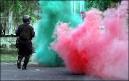 A police officer is confronted by red tear gas assault by students
This situation in Nicaragua reminds me of the food riots and looting that started in Guarenas, Venezuela, about 15 miles from Caracas on February 27th 1989. That eruption led to constitutional guarantees being suspended and police and troops sent out on to the streets to massacre the poor. Officially about 352 people died in Venezuela on that and the following day, but in reality it was more than 3000 many of whom were buried in mass graves. This was the unacceptable face of neoliberal policies being implemented in Venezuela by the then president Carlos Andrez Perez. The same spark of transport fares has triggered these demonstrations in Nicaragua.
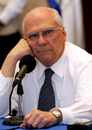
President Enrique Bolanos hears from the mayors: "Solve the conflict or resign!"
Almost all the mayors in the country (152 in total) met on Monday and issued a declaration to president Bolanos saying that if he could not resolve the conflict, he should resign. Public transport continues at a standstill. Demonstrations are being dispersed with tear gas regardless of the presence of women, children and senior citizens involved.
The government has not responded to the mayors' declaration and to cap all this, in a country so submissive to capital interests, the World Bank and the IMF issued statements saying:
- All aid would be suspended to Nicaragua
- Nothing should be subsidized and
- The country had to comply with all the agreements signed with these international and US influenced institutions.
Where is the concept of Nicaraguan national sovereignty if the World Bank and the IMF are giving the orders? Is there any need for President Bolanos if he is so in hock and under the thumb of these institutions? Answers to these questions can be summed up in three words: Global Corporate Empire. It respects no national boundaries, makes its own rules as it puts its foot down in any country it chooses and executes its for-profit-decisions without mercy to those who fall prey to its ever-changing policies.
On Tuesday, one of the marches reached the presidential palace and Bolanos in a moment of bravery ventured out to speak to the protesters and was greeted by a hail of stones and bags of water. His son was slightly injured in the incident. After this, Bolanos decided to use the power of the police to break up the demonstrations and accused the leader and presidential candidate of the FSLN, Daniel Ortega, of stirring up the protests against him.
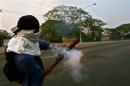
Students clash with Nicaraguan Police, protesting neoliberal policies of the Bolanos regime
The populace stood up to the police and demonstrations took place in other major cities such as León, Jinotepe, Estelí, Jinotega y Matagalpa. To all intents and purposes a platform of popular struggle has emerged to protest against the application of these neoloiberal policies. Nicaraguan workers are the lowest paid in Central America and suffered greatly after the catastrophe of hurricane Mitch in October 1998, which devastated much of Nicaragua and Central America.
The transport leader, Rafael Quinto, in a defiant mood in the face of the police repression said that the protests would continue indefinitely until the government adopted a more responsible attitude.
Even the President of El Salvador, Tony Saca, expressed concern about the situation in Nicaragua saying that the constitutionality of the country should not be broken. This was an indirect reference to what occurred in Ecuador last week. He also indicated that any breaking of the constitutional order could have knock-on effects in other Central American countries. Perhaps, President Saca knows that the whole of Central America is a powder keg and protests just need one spark to ignite it and unleash all the pent up feelings of resentment in people who have been exploited by US imperialism and their corrupt Latin American governments for more than a century.
In contrast to the institutional concerns of the President of El Salvador, the Nicaraguan people who have suffered so much, are now united against the principal agent of neoliberalism in the country, namely President Enrique Bolanos.
It is ironic that the protests in Nicaragua coincide with the visit of Condoleeza Rice to El Salvador, after the protests in Colombia against her presence in that country. Even the fenced off Colombian media could not hide the protests this time in downtown Bogota.
We await further developments, but it appears that throughout Latin America, the tide has turned against the US application of neoliberalism via the World Bank and the IMF to exploit the poor and steal their childrens' future.
Annex:
So that readers can better appreciate the historical context of what has now erupted in Nicaragua, herewith a brief synopsis of the situation in Nicaragua from 1909 onwards:
The Nicaraguan people were under the jackboot of the US with troops present at the end of the first decade of the 20th century, invoking the 1823 Monroe Doctrine. In 1909 the US provoked the overthrow of President José Santos Zelaya and subsequently sent troops in to depose José Madriz in 1910, setting up a puppet regime under Adolfo Diaz. This enabled them to take control of the country including the railways, the steam ship company and funds in the national treasury. The US occupied Nicaragua for 13 years up to 1925.
US troops returned in 1927 as a response to the Constitutional War and by this time Nicaraguan national hero and freedom fighter, Augusto Cesar Sandino (1895 - 1934) was active fighting against the troops of the conservative Jose Maria Moncada. Sandino won various battles and finally the conservative army is defeated. However, Sandino refused to sign an armistice brokered with Moncada by Henry Stimpson, emissary of President Calvin Coolidge. Sandino declared his intention to fight on until the US withdraws its troops from Nicaragua.
In 1928, in elections supervised by the U.S. Marines, the traitor Moncada was elected President and tried to secure military aid from Mexico which was denied. The civil war continued until 1932 when Juan Bautista Sacasa was elected President. Sacasa had solicited the continued presence of US troops in Nicaragua and this was denied. On January 1st 1933, the Sandinista caused triumphs when US troops were finally withdrawn and a peace treaty was signed between Sacasa and Sandino in May 1993.
At this point Anastacio Somoza Garcia appeared as the head of the Nicaraguan National Guard. This was the start of the Somoza dynasty in Nicaragua. Despite the peace treaty, Somoza's forces continued to pursue Sandino's men. After repeated complaints, Sandino negotiated again with Sacasa and while returning from a dinner with Sacasa, Sandino was brutally assassinated by two generals acting on Somoza's orders.
For a more complete history of Nicaragua, the genocide of the Somoza
dynasty, the repression of the Sandinista National Liberation Front and the tumultuous political situation in Nicaragua from 1933 to 2001 go to the following link: http://www.moreorless.au.com/killers/somoza.htm
Note that human rights violations were never brought against anyone after the mass slaughter in Nicaragua from 1933 onwards until the UN passed a resolution condemning the Nicaraguan government in 1978. The bombing by the US of civilian targets in 1927 during the war with Sandino was never condemned.
"Sandinismo" is for many Nicaraguans I have met, almost like a religion. I predict that the FSLN will make a comeback after losing the elections in 1990, 1996 and 2001. Since 2001, with the advent of the Bolivarian Revolution in Venezuela, Latin America has changed in terms of consciousness. The ruling class is becoming more desperate - and less discriminating, in the face of the rising masses who are realizing their power. We may see the empire may pull out all the stops and go for broke if they sense the possibility of defeat. Of course we have been watching this take place in Iraq as they smell the increasing power of the Iraqi resistance. On the other hand, this brutal application of neoliberal policies is encouraging Latin American voters to "turn left'. The drama unfolding in Latin America is nothing less than spectacular!
I remember seeing Daniel Ortega of the FSLN speak in Caracas in April 2002 and he said one thing which has always stuck in my mind:
"The main thing a revolution gives the people is a feeling of self-esteem and self-worth".
In other words - human dignity.
© Copyright 2005 by AxisofLogic.com
Read Carlos Herrera's bio on Axis of Logic. His reports on the progress of the Bolivarian revolution in Latin America can be found in his:
You can contact Carlos Herrera at: carlos@axisoflogic.com
Carlos Herrera is also a regular writer on the Bolivarian Republic of Venezuela at VHeadline