On April 20, 2005, Axis of Logic was one of the first news media in the world to break the story of the removal of Lucio Gutierrez from office of president in Ecuador. He was quickly replaced by then Vice President, Alfredo Palacios.
By way of Internet contacts, I received this message from Joseph Pena jpena16@comcast.net, who is involved in a group of well informed, committed Bolivarians. His comments about the change of President in Ecuador and how it was manipulated are indeed food for thought.
"As I expected the trick of replacing the president by the Vice-President (or castling if you were playing chess) worked well on the middle class. They are totally demobilized and happy for their success. The media is playing along very hard and backing up the coup. You might ask the coup? It was a legitimate presidential succession after the Congress removed him? Well, no it wasn't.
"The congress gathered in a different building (as they could not reach the normal building for the demonstrations) and voted to remove Lucio Gutierrez for "abandono del cargo" (abandoning his post). After the announcement that Lucio goes on national media reading his last decree as president where he appoints a new head of the police among other changes. In other words Lucio was removed from office for abandoning his post while he was still taking presidential decisions! A phony reason!
"Furthermore, the constitution dictates that the congress needs 2/3 of the votes to remove the president. In a congress of 100 members that is 66 votes. The emergency congress that joined had only 62 members, only 60 f which voted to remove Lucio from office. In other words they were 6 votes short of the constitutional requirement to remove a president. The removal of Lucio, as the military retired their support, is unconstitutional, a coup de tat. The OAS as well as the Union of South American Nations has not made any statement yet about acknowledging the current government as legitimate.
"Why was Lucio removed from power if there was not a real public rising up against him? Why did he relinquish power at 14:28 on the 20th after saying on the night of the 19th that he would not resign and played tough? The answer might be in the fact that early in the 20th he was visited by the ambassador of the US!! Why the US would want anything to do with it? Well, for starters, the position of Ecuador is critical back up for Plan Colombia and their plans in South America. Should Ecuador turn toward a real sovereign state it would isolate their operation in Colombia.
"Secondly, the US has a gigantic military base in the city of Manta at the pacific shore. This base not only helps Plan Colombia in Colombia but also helps keep military presence in all of southern Central America (recall that Central America bends south in Panama).
"Third, Ecuador has a large, and undeveloped, oil potential in the Ecuadorian Amazon and we know how Washington feels about oil.
"Fourth, Ecuador is, as I type this, negotiating the Tratado de Libre Comercio (TLC) (Free Trade Agreement with the US) with all the Andean countries (Ecuador being one of the most stable of them) and every problem here could reflect in problems in the results of the negotiations."
This analysis by Joseph Pena indicates that there was indeed a coup d’etat in Ecuador, orchestrated by the Congress, the military who withdrew their backing for Gutierrez and the US. The Community of South American Nations has not made any declarations so far and the OAS is due in Ecuador tomorrow to investigate exactly what happened. In effect, Gutierrez was removed unconstitutionally.
The US Ambassador, Kristie Kenney continues to make glib statements saying that the US wants to promote more democracy in Ecuador. What sort of democracy? Democracy that favors Washington’s interests, and those of the global corporate empire? Most certainly not democracy within the context of the Ecuadorian Constitution.
New "President", Alfredo Palacio, has been making statements about holding a Constituent Assembly, about not extending the lease of the US military base at Manta which expires this year. The US wants to renegotiate the deal for an additional five years. However, Ecuador has now offered itself as the venue for the next round of talks on the Free Trade Agreement with the US which will be negotiated together with Peru and Colombia. This agreement, if signed and ratified, will certainly further US interests in the region and undermine South American unity.
Readers must be made aware that the indigenous movements had very little to do with the street demonstrations that encouraged Congress to illegally vote Gutierrez out. Most of the demonstrators were middle class Ecuadorians as can be seen from the photos published in the press. Even the right wing mayor of Guayaquil, Jaime Nebot, organized demonstrations against Gutierrez. There appears to be dark interests at work in Ecuador and the "solution" to this impasse is not exactly clear.
Analysis of the geopolitical and geostrategic issues at stake
This week, US Secretary of State, Condolezza Rice is due to begin her Latin American tour with stops in Brazil, Colombia, Chile and finally El Salvador. We believe that the purpose of the itinerary is to rally support for the Mexican candidate for OAS General Secretary, Luis Ernesto Derbez, in preparation for next week’s vote in the OAS. At the same time, the US has made no secret of the fact that it would like to isolate Venezuelan President Hugo Chavez as being the "negative force in the region" due to the alleged arms race of which he accused by the U.S. and/or due to U.S. accusations that he is getting cozy with North Korea. He is now even being accused of developing nuclear weapons with Cuba!! Do these accusations ring bells of "weapons of mass destruction?"
This sort or reporting has been prevalent in the US right wing press and Internet lately, thus creating a "matrix of opinion" on these matters, when there is zero substance to them.
In addition, if in the OAS, Gutierrez’s removal can somehow be justified, this would open the door for more destabilization attempts in Venezuela with a view to machinating a similar fate for Chavez, since the US knows that it is impossible to defeat Chavez democratically in the December 2006 elections. Washington needs crude oil even though it lacks refinery capacity.
In fact, if the US backed candidate does become OAS General Secretary, it could open the door for the amending of the OAS Democratic Charter and lead to the "democratic letter" being applied to both Ecuador and Venezuela as being "unstable". Such a move could pave the way for some sort of intervention in order to protect oil supplies and US national security using the Monroe Doctrine of 1823 as the legal framework.
How to integrate South America
Ecuador is strategically located on the Pacific coast of South America and if it were to pull out of the US orbit of influence, the move would prejudice Washington’s main investment in the region – that is, the regionalization of Plan Colombia, and effectively isolate the Colombian regime of President Uribe Velez in the Andean region.
We must be aware that the whole of South America has been difficult to integrate historically and economically due its topography as well as the massive Amazon rain forest. The same has always been true of Central Africa and the Congo. The solution is to build canals to link the main huge South American river complex into navigable waterways. Chavez spoke about this two years ago.
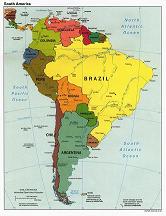 Looking at a map of South America, the Amazon River rises in Peru, heads north and turns "sharply" to the right and crosses the whole continent through Brazil and finally drains into the Atlantic Ocean. The location of the "bend" is to the right is a crucial and geostrategic point. Engineers have plans to build a canal from this point to the Pacific Ecuadorian coast city of Guayaquil, thus creating an inter-oceanic waterway from the Atlantic to the Pacific. (This inter-oceanic waterway is known as the Bioceanic corridor of Amazonia). Heavy machinery could be transported more effectively, as well as foodstuffs, without using the Panama Canal of sailing around Cape Horn. Air transport is simply not viable for heavy trade goods.
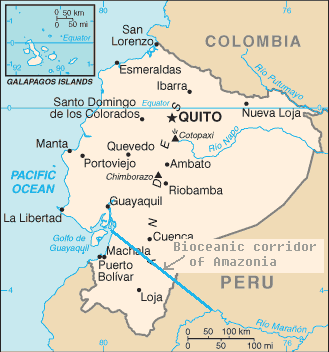
Thus, Ecuador and the province of Guayaquil is strategically very important to facilitate the real integration of South America in the long term. This would completely revitalize the South American economies, especially that of Brazil, and prejudice US economic dominance in the region. This is yet another reason why the US cannot afford to lose control of Ecuador and the reason they insist on negotiating the FTAA longer term.
We are also aware that there have always existed separatist tendencies in Guayaquil as Ecuador’s largest city and their hub of trade and commerce. It tried to declare itself independent during the days of Bolivar and more recently during Gutierrez’s military rebellion in 2000 against ex-President Mahaud. At that time, ex President of Ecuador, León Febres Cordero (1984 – 1988), threatened the separation of Guayaquil from the rest of the country. This influential politician is still active in and forms part of the Guayaquil oligarchy and still harbors a desire for the Nation of Guayaquil.
The same applies to Colombia, whose largest river, the Magdalena drains into the Caribbean Sea to the east of Panama. Linking up the river system in Colombia would create a waterway from the Caribbean to the Pacific as an alternative to the Panama Canal. However, in this region, even with Plan Colombia, the US and Colombian governments have been unable to defeat the guerrilla movements, in particular, the Colombian National Liberation Army, (ELN). These plans have been on ice for many years.
Thus, the integration and the strengthening of South America depends on several factors in order to defend itself against US ambitions and the dominance of the global corporate empire:
- Political integration
- Integration in the framework of the ALBA – Bolivarian Alternative for America placing the human being at the center of the world and not the profits of the multinationals
- The development of a common currency
- A Latin American Monetary Fund
- A Latin American Central Bank
- A Latin American Humanitarian Fund to immediately address poverty in the region
- Petrosur to make the most of existing hydrocarbon reserves for the benefit of the people of the region and not the oil and gas multinationals
- TV Sur and Radio Sur to inform people and counter current US dominance airwaves
- Waterways linking the continent for internal trade
- Consolidation of the South American Community of Nations to implement these geopolitical and geo strategic plans.
This is the overall picture of South America and one can easily appreciate the fact that Ecuador is vital in this international chess game. Energy is also one of the primary keys as it will be the driving force behind economic and political integration.
The US has an awful lot to lose and will do everything in its power to weaken the resolve of malleable presidents in the region. Let’s wait and see what develops in the coming days with the Visit of Condoleeza to these shores, the visit of the OAS to Ecuador and the coming vote in the OAS Assembly to elect a new General Secretary.
Just as the control of one vital square in a chess game can lead to victory or resignation, Ecuador finds itself in a pivotal position. The whole of South America could become an integrated bloc or end up fragmented, under control of the U.S. led empire. I, for one, would not predict the outcome of this extremely complex situation since we Latin Americans can never underestimate the power, plans and influence of the US in our region.
© Copyright 2005 by AxisofLogic.com
Read Carlos Herrera's bio on Axis of Logic. His reports on the progress of the Bolivarian revolution in Latin America can be found in his:
You can contact Carlos Herrera at: carlos@axisoflogic.com
Carlos Herrera is also a regular writer on the Bolivarian Republic of Venezuela at VHeadline