Touching the Revolution at IVIC: Instituto Venezolano de Investigaciones Cientificas (The Venezuelan Institute of Scientific Research) and an interview with Dr. Alberta Lucchi
Simón Bolívar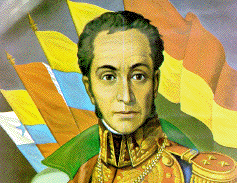
"The role of the inhabitants of the American hemisphere has for centuries been purely passive. Politically they were non-existent. We are still in a position lower than slavery, and therefore it is more difficult for us to rise to the enjoyment of freedom. We were removed from the world in relation to the science of government and administration of the state. We were never viceroys or governors, save in the rarest of instances; seldom archbishops; diplomats never; as military men, only subordinates; as nobles without royal privileges. - Simón Bolívar, 1815
The blood of Simón Bolivar pulses through the veins of The Venezuelan Institute of Scientific Investigation (IVIC) and his spirit rests lightly on the consciousness of those who carry out the work of this prestigious institution. The same high performance engine that powers the Bolivarian revolution in Venezuela's cities, barrios and countryside drives those who work at IVIC. Many examples of this phenomenon can be cited, but the best proof is to experience it personally by being there. Bolivar's spirit shows on the faces and in the pride these people have in their land, government and culture.
During our visit at IVIC, on the day following my arrival in Venezuela, I experienced the first wafts of the prevailing revolutionary spirit and positive energy of that flows through Venezuelan society. It is the spirit of an empowered people and it is expressed in a Spanish term that has no English equivalent. Earlier in this series, I promised to introduce that term and plan to do so in the final report in this series: Touching the Revolution in La Victoria!
My friend and colleague, Roy Carson, Editor of VHeadline and I visited IVIC on February 10, 2005. Following our visit, I likened the work done at IVIC with the research conducted and training provided at M.I.T. here, in Cambridge, MA. Dr. Maximo García Sucre, Ph.D. and Dr. Raul Padrón, Ph.D., Director and Deputy Director, respectively, were our hosts for the all-day visit. At their invitation, I also had the opportunity to speak to an assembly of IVIC's workers who were starting their courses on the Mision Rivas and Mision Sucre.
Dr. Maximo García Sucre, Ph.D., IVIC Director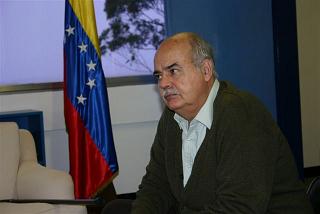 The facilities at IVIC occupy a quiet, natural reserve, located on the top of a mountain about an hour from Caracas, surrounded by over 3,000 acres of beautiful rain forest. IVIC was originally created as
"IVNIC" in 1954, under the leadership of Humberto Fernández-Morán who was a scientist trained in Germany and Sweden - a pioneer in Neurology and Electron Microscopy. The institution was renamed in 1959 as IVIC and organized within the Departments of Structural Biology, Department of the Study of Science and the Department of Mathematics, as well as in centers for Anthropology, Biophysics and Biochemistry, Ecology, Physics, Experimental Medicine, Microbiology & Cellular Biology and Chemistry. IVIC conducts basic research and offers training in these disciplines. At this time, 103 research scientists, 154 professionals, 76 technicians and 27 postdoctoral fellows are working at IVIC. A total compliment of 1265 people work at IVIC when contracted employees, support staff, pensioners and facility maintenance workers are included.
On the IVIC website, Dr. Roberto Callarotti, Head of the Center for Technology at IVIC, writes:
"The Technological Center in the Venezuelan Institute of Scientific (IVIC) Investigations, is the instance, through the one which the scientific and technical personnel, offers at national and international level his knowledge and advanced technology reached starting from the excellence principle, creativity and perseverance."
IVIC was once insulated, excluding many Venezuelan citizens from access to its programs. Now, under the Chavez administration it has opened its doors with the creation of a center for the community by including effective programs for literacy and secondary education for their own workers who require it, as well as funding to improve the teaching of science to primary and secondary school students in the communities. These programs are designed to enhance their scientific education and for access to IVIC. This is a new program created by Drs. Sucre and Padrón following their appointments to positions of Director and Deputy Director of IVIC in October, 2004. Details of these changes will be reported in my interview with Hildemaro Mago, Cronista Municipal, a professor who works with Mision Sucre where people receive preparation for higher education.
A full panorama of the mission, programs and the wonderful work of IVIC goes far beyond the scope of this article. The IVIC website is written in Spanish, but the Internet translator provides a sufficient translation into English to give the reader an opportunity to tour the splendor of this premier institution. The reader can also take a lovely virtual tour of the Art Gallery at IVIC.

The Plaza at IVIC
The third installment of this series, Touching the Revolution! is an attempt to describe my impressions of the people and atmosphere as I experienced them at IVIC. It will also include the first of a subset of interviews I conducted with research scientists, faculty and directors of this institution. The first of those interviews, published below is with Dr. Alberta Zucchi, Deputy Director of IVIC's School of Anthropology. Others will be published in coming days.
"Do not adopt the best system of government, but the one that is most likely to succeed. Unity, unity, unity, must be our motto."
-Simon Bolivar
When visiting The Bolivarian Republic of Venezuela anyone will observe obvious differences in income, lifestyle and standard of living among Venezuelan people. Because of their education, training and backgrounds, these high achieving women and men at IVIC are of course, living differently than the very poor in the barrios. However, there were no traces of the pretensions and attitudes of entitlement at IVIC that we so often see in U.S. culture. I found a parallel to this observation, when I spent two days in the barrios. There, I found the same warmth and a surprising absence of anger, envy or societal depression among the people whom I met and randomly interviewed. I suspect this is in part due to the fact IVIC and Bolivarian University has reached out to the community and has now been made accessible to those who could never have afforded or gained access prior to the Presidency of Hugo Chavez Frias.
I was particularly interested in the personalities and attitudes of those who work at IVIC, including those in leadership positions. This curiosity on my part was part of a larger scope of interest in the way lives are lived and work is performed at all levels of a Bolivarian society. Dr. Padrón is presented here as an excellent example among the personalities of folks I met at IVIC:

Raul Padrón, Ph.D., Deputy Director and Research Scientist: In addition to his administrative duties, this eminent scholar/scientist is Senior Investigator at the Structural Biology Laboratory, Department of Structural Biology at IVIC. He received a Ph.D. in physiology and biophysics from the institute and conducted postdoctoral research at the Medical Research Council Laboratory of Molecular Biology in Cambridge, United Kingdom. He has also been a visiting scientist at the European Molecular Biology Laboratory (EMBL) in Hamburg, at the Science and Engineering Research Council and at the Medical Research Council in the United Kingdom, and the University of Massachusetts Medical School in the United States. Dr. Padrón's honors include CONICIT biology awards, a CONICIT PPI Fellowship, and the 1991 Polar Science (Biology) Award. The latter was his second HHMI International Research Scholar award. The project on which he is currently working involves the structure and function of the myosin filaments of striated muscle.
In my second installment of the series, Touching the Revolution!, I described the people working at IVIC thus:
"Despite their achievements and prestige in academia, the people at IVIC are not the stodgy academics one often finds in similar institutions in the U.S. They are affable, exciting and eager to share their knowledge with people from all socio-economic and academic backgrounds."
Raul Padrón, the person: Although we had never met before, Dr. Sucre and Dr. Padrón graciously invited us into their offices and IVIC’s conference room with an extension of friendship and brotherhood. These men generously set aside the better part of a day for our visit and arranged for my presentation in assembly and interviews with IVIC professionals. We were welcomed as guests in the home of a friend. Like Dr. Sucre, Dr. Padrón was inquisitive and interested in our work as we were with his. It was my impression that by his leadership and example, a refreshing sense of common humanity is realized among scientists, faculty and staff, regardless of position. While the division of labor was fully present in this highly organized institution ... from the directors to the scientists to the support staff, I witnessed no airs of privilege or hierarchy. As a host, Dr. Padrón was so adept as host that any apprehensions I may have had upon arrival quickly dissolved. Here in these prestigious halls, I experienced the same warmth and common ground as in the days following when I met folks in the barrios and on city streets. For me, it was telling.
A warm reception in a "well appointed home"
Roy Carson, Editor, reviews VHeadline with group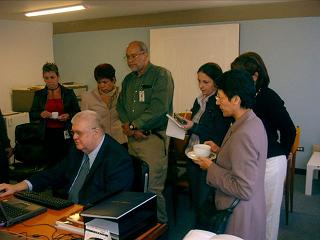 Our visit began as Roy Carson, Editor and Publisher, reviewed the website of VHeadline on an on-line computer with a group gathered for our visit.
The media review was followed by a meeting where we got to know one another in an administrative lounge that offered the distinct feel of the living room of a friend’s well-appointed home. I was then invited to begin a series of interviews which lasted throughout the day. These were organized in advance of our visit. Drs. Padrón and Sucre had also organized an assembly where several IVIC and Mision Rivas Officers gave presentations to an audience of about 50-75 IVIC workers. Oh how I wished I had spent more time working on my abysmal language deficiency for an understanding of their words! Following these presentations, I was invited to talk to the assembly. When I opened the talk with the words: "Venezuela Magnifico!" - the Bolivarian Republic of Venezuela received a long, enthusiastic applause by these committed Bolivarians. Professor Hildemaro Mago then kindly came to my rescue and interpreted the rest of the presentation on impressions of Venezuela that have been created by the U.S. media and held by many U.S. citizens. Those in attendance listened attentively and appeared to be very much interested in the discussion. Following an afternoon of interviews, the participants of the day were invited to a splendid dinner at a large roundtable in the facility’s dining room with a magnificent view of the surrounding rain forest in this northmost end of Andes mountains.
America is ungovernable; those who have worked for independence have plowed the sea.
-Simon Bolivar
Interview with Dr. Alberta Zucchi
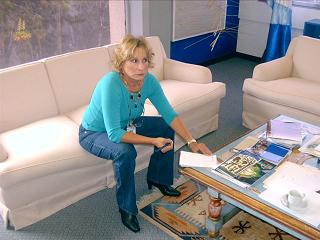
Dr. Alberta Zucchi is Deputy Director of Anthropology at IVIC. She is a distinguished archeologist with a rich history of field experience and basic research in the history and culture of the indigenous
peoples of the Middle Orinoco River region.
Axis of Logic thanks Dr. Alberta Zucchi who was kind enough to take time from her busy schedule to provide the first interview for this series.
LMB: Thank you for taking time from your busy schedule for this interview.
AZ: Thank you, it is my pleasure.
LMB: May I begin by asking you about yourself? I think our readers would enjoy reading something about your background.
AZ: Yes, of course.
LMB: Could you tell me about your education?
AZ: I obtained my undergraduate degree at Central University before entering IVIC where I obtained my doctorate in physical and social archeology.
LMB: Have you always lived in Venezuela?
AZ: No, I was born in Italy and moved to the Bolivarian Republic of Venezuela at an early age with my family in 1948, when my father received a government contract to work as a medical doctor.
LMB: How did your father happen to move to Venezuela to practice medicine?
AZ: At the time Venezuela needed professional people as Venezuela was a very rural country. My family lived in a small town where my father practiced medicine, but he lost his position due to the Minister of Health who at that time claimed that foreign doctors were taking the jobs of Venezuelan doctors. So we remained in Venezuela and my father prepared and obtained a Venezuelan medical license and resumed his work as a physician.
LMB: And throughout these years, did you go to public school in Venezuela?
AZ: No during this time with my father’s trouble in his profession, my mother became worried about my welfare, so she sent me to a boarding school in Barbados. It was an English speaking system under British control. It was a British colony. I went to the school from elementary school through high school.
LMB: And after graduation from high school, you entered the university?
AZ: After I graduated from high school, I moved back to Italy for a period of time and stayed with relatives. Then I returned again to Venezuela and I took a position as an airline stewardess. While I was working in this job, I realized that I wanted to do more with my life. So I decided to go to Central University (UCV) in Caracas and there I obtained my baccalaureate degree in archeology.
LMB: How did you become interested in archeology?
AZ: I have always been interested in archeology and thought I would like to work as an archeologist.
LMB: And after graduating from Central University, you went on to graduate school?
AZ: Yes, following graduation, I entered IVIC and completed my doctorate in 1967.
LMB: Where did you do your field research when you began your studies in archeology?
AZ: My first project was a dig in Venezuela’s Central Plains; later I moved to the Western Plains to conduct more research.
LMB: So from the Central Plains you moved to projects in the Western Plains?
AZ: Yes, earlier, the Director of the Archeology Department at Central University had written a book on archeology in the Western Plains, but he only had 'relative dates' of confirmation of his findings. So I moved my work to the Western Plains and began digs to do C-14 studies on artifacts.
LMB: What kinds of things did you find in these digs?
AZ: Oh ... we uncovered artifacts such as pottery and stone axes. We excavated an earth mound - the site of an ancient village and another time, a causeway. Some of the artifacts dated back to 1000 B.C.
LMB: This sounds like tough work but also very interesting.
AZ: Yes, back then there were no bridges to some of these sites and I had to drive through rivers to conduct my work.
LMB: So what was the result of your findings in the Western Plains?
AZ: I wrote my doctoral dissertation based on my findings and went on to begin projects in other sites. As is often the case in archeology - you answer one question which opens 25 more!
LMB: Where did your work take you after you completed your doctoral dissertation?
AZ: Well, then I took my to work in the Middle Orinoco River region. There are large Indian populations in these areas. I worked on the frontiers of Colombia and Venezuela along the Orinoco and other rivers. The Arrwakan Indians were very much interested in the work I was doing because of their sacred places and ancient lands in the area.
LMB: Why were the Indians so interested in your work?
AZ: The Arrwakans and other Indian groups worked closely with me and began using the information to reclaim their ancient lands. Now these Indians are learning the concept of property ownership. This in turn, benefits them through the Land Reform measures embodied in the Venezuelan constitution.
LMB: How does the Venezuelan Constitution benefit the indigenous people in this way?
AZ: This constitution* recognizes the pre-occupation of land by the indigenous population. I have been involved with establishment of a directory of the ancient lands of the indigenous people so they can trace their own history with the land.
LMB: Dr. Zucchi, thank you so much for taking time out of the middle of your day for this interview. You have had amazing experiences in your life. I know the readers of Axis of Logic will enjoy reading about you and the wonderful work you are doing!
AZ: Thank you for interviewing me and your interest in my work.
(*The Constitution of Venezuela was drafted by the Chavez Administration and ratified on December 15, 1999 by approximately 70% of the Venezuelan people. The Venezuelan Constitution is unique to the world in that it was ratified by a national referendum [the people], rather than by the leadership of the country.)
The foundations of the living, breathing Bolivarian Revolution in Venezuela and the nation's constitution were laid by Simón Bolivar, the great liberator of Latin American countries from Spain in the 19th Century. Bolivar’s passion for defending national sovereignty and uniting Latin American countries permeates the brick and mortar at IVIC, the people who work there and the land on which this splendid institution stands. Today, 200 years later, his spirit has awakened the people of the Bolivarian Republic of Venezuela for independence, sovereignty, self-determination and freedom from exploitation and colonization by foreign countries.
Touch the revolution.
It can happen here, in the United States.
© Copyright 2005 by AxisofLogic.com
Touching the Revolution! - The Series
Additional interviews of professional people working at IVIC will follow this one in coming days.
The following future installments in the Touching the Revolution Series will be published in months ahead:
•
Touching the Revolution! - in the Barrios•
Touching the Revolution! - in Caracas•
Touching the Revolution! - The Opposition•
Touching the Revolution! - in La Victoria